
Introduction
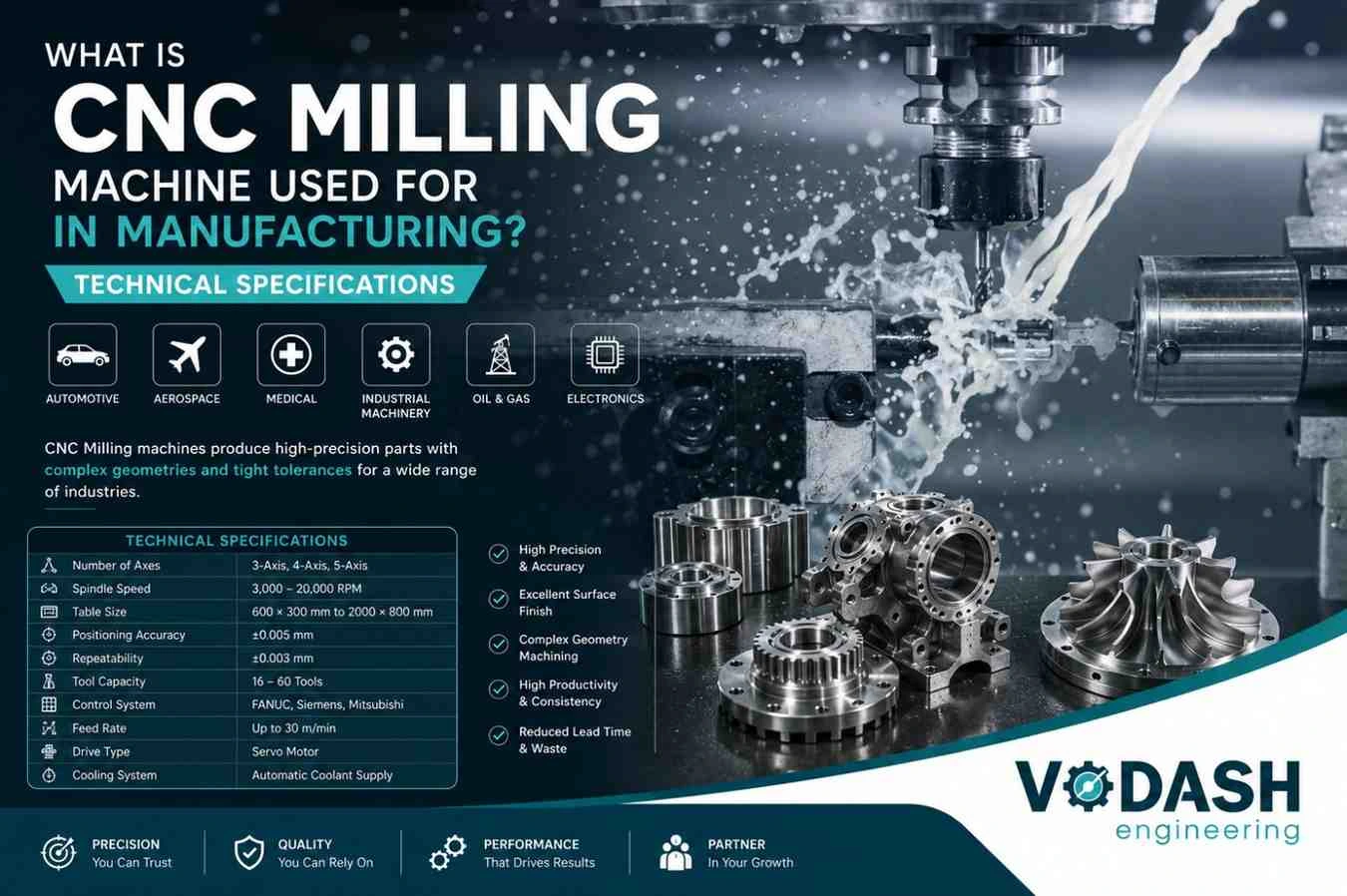
CNC Milling is one of the most advanced and widely used manufacturing processes in modern industry. It uses computer-controlled cutting tools to remove material from a workpiece and produce highly accurate components with complex shapes and tight tolerances. CNC Milling technology has transformed industries by improving production speed, consistency, and product quality. It is often used alongside the Metal Casting Process to manufacture complex industrial components with exceptional accuracy.
Today, CNC milling machines are widely used in automotive, aerospace, medical, railway, electronics, oil & gas, and heavy engineering industries to manufacture precision-engineered parts for critical applications.
Key Takeaways
- CNC Milling is a computer-controlled machining process used for producing highly accurate components.
- CNC Milling machines are widely used across automotive, aerospace, medical, and industrial sectors.
- Modern CNC Milling machines offer high spindle speeds, tight tolerances, and automated operation.
- The process supports a wide range of metals and engineering plastics.
- Advanced CNC technology improves manufacturing efficiency, consistency, and product quality.
What is CNC Milling?
CNC Milling (Computer Numerical Control Milling) is a subtractive manufacturing process where rotating cutting tools remove material from a stationary workpiece according to programmed instructions.
Unlike manual machining, CNC Milling is fully automated and controlled by computer software, allowing manufacturers to achieve exceptional accuracy and repeatability.
Key Features of CNC Milling
- High dimensional accuracy
- Tight tolerance control
- Excellent surface finish
- Fully automated operation
- Suitable for complex geometries
- High production efficiency
What is a CNC Milling Machine Used For?
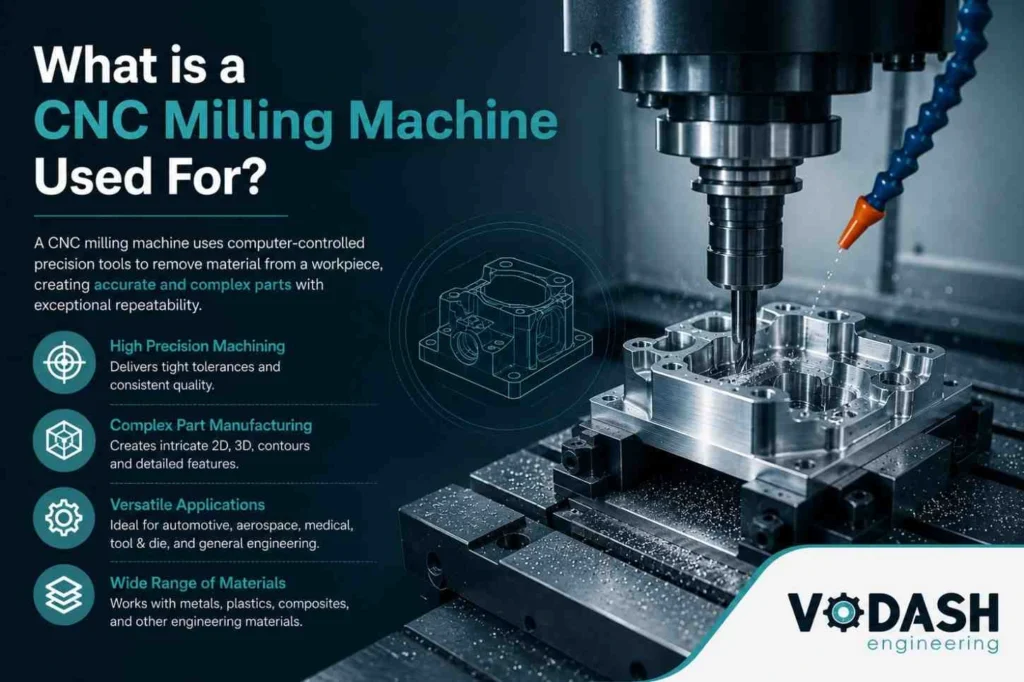
A CNC Milling machine is used to manufacture high-precision parts that require precise dimensions, intricate designs, and consistent quality, making it a key technology in modern Precision Machining Services.
Common CNC Milling Operations
- Face Milling
- Plain Milling
- Slot Milling
- Angular Milling
- Profile Milling
- Pocket Milling
- Drilling
- Tapping
- Boring
Industries That Use CNC Milling Machines
| Industry | Typical Applications |
| Automotive | Engine Parts, Gear Housings |
| Aerospace | Structural Components, Turbine Parts |
| Medical | Surgical Instruments, Implants |
| Railway | Connectors, Brackets |
| Oil & Gas | Valves, Pump Components |
| Electronics | Enclosures, Heat Sinks |
| Industrial Machinery | Custom Machine Parts |
How Does the CNC Milling Process Work?
The CNC Milling process follows several carefully controlled stages.
Step 1: CAD Design
Engineers create a 2D or 3D digital model of the component.
Step 2: CAM Programming
The design is converted into machine-readable G-code instructions.
Step 3: Machine Setup
The workpiece and cutting tools are securely mounted.
Step 4: Machining Operation
The CNC Milling machine removes material according to the programmed path.
Step 5: Finishing
Additional processes improve surface finish and dimensional accuracy.
Step 6: Quality Inspection
The finished component undergoes inspection and testing.
CNC Milling Machine Technical Specifications Description
The technical specifications of a CNC Milling machine may vary depending on the machine type and manufacturer. However, most industrial CNC Milling machines share common features.
| Specification | Typical Range |
| Number of Axes | 3-Axis, 4-Axis, 5-Axis |
| Spindle Speed | 3,000 – 20,000 RPM |
| Table Size | 600 × 300 mm to 2000 × 800 mm |
| Positioning Accuracy | ±0.005 mm |
| Repeatability | ±0.003 mm |
| Tool Capacity | 16 – 60 Tools |
| Control System | FANUC, Siemens, Mitsubishi |
| Feed Rate | Up to 30 m/min |
| Drive Type | Servo Motor |
| Cooling System | Automatic Coolant Supply |
Materials Used in CNC Milling
Modern CNC Milling machines can machine a wide variety of materials.
Common Materials
- Stainless Steel
- Carbon Steel
- Aluminum
- Brass
- Copper
- Titanium
- Bronze
- Engineering Plastics
Advantages of CNC Milling
CNC Milling offers several benefits over conventional machining methods.
Key Benefits
- Exceptional precision
- High repeatability
- Faster production cycles
- Reduced human error
- Excellent surface finish
- Ability to create complex parts
- Lower material waste
- Consistent product quality
CNC Milling vs Conventional Milling
| Feature | CNC Milling | Conventional Milling |
| Accuracy | Very High | Moderate |
| Automation | Fully Automated | Manual |
| Production Speed | Fast | Slower |
| Repeatability | Excellent | Limited |
| Labor Requirement | Low | High |
| Complex Designs | Easy | Difficult |
Applications of CNC Milling
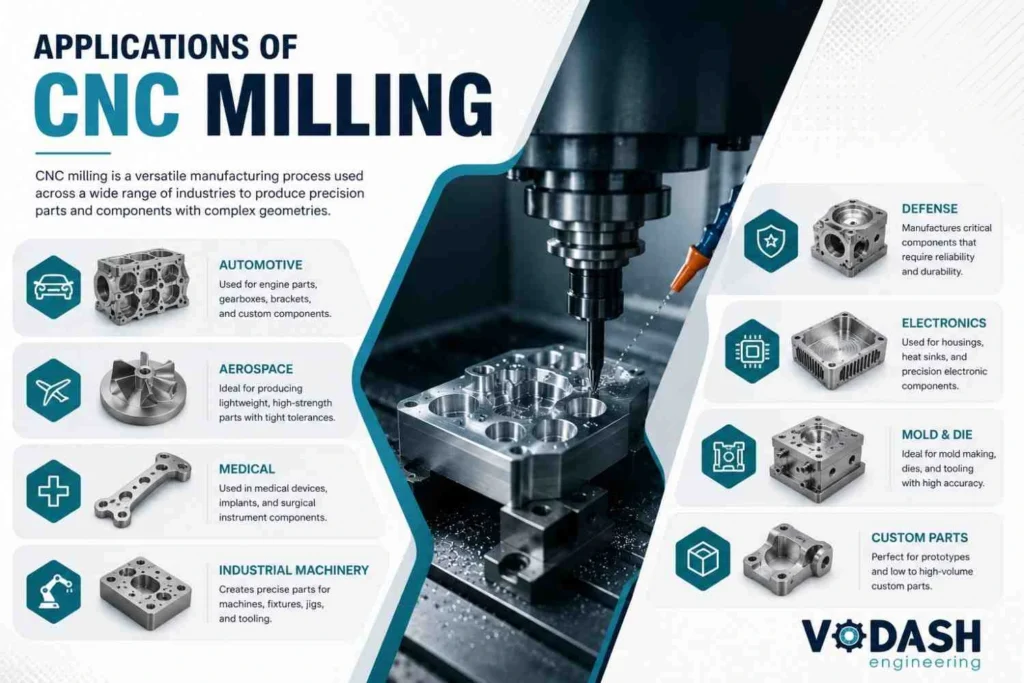
CNC milling is used for manufacturing a wide range of industrial components supplied by a trusted Casting Manufacturer for automotive, aerospace, and heavy engineering applications.
Common Products
- Engine Blocks
- Pump Housings
- Gear Components
- Mold Cavities
- Medical Instruments
- Aerospace Fittings
- Industrial Machine Parts
- Electronic Enclosures
Future of CNC Milling Technology
The CNC Milling industry continues to evolve with smart manufacturing technologies.
Emerging Trends
- AI-powered CNC machines
- Multi-axis machining systems
- Robotic automation
- IoT-enabled machine monitoring
- Digital twin technology
- Sustainable manufacturing practices
These innovations help manufacturers improve productivity while maintaining exceptional quality standards.
Conclusion
CNC milling has become an essential manufacturing process for producing highly accurate, durable, and complex components across a wide range of industries. By combining advanced computer-controlled technology with precision cutting tools, CNC milling machines deliver exceptional dimensional accuracy, consistent quality, and improved production efficiency.
Also Read : https://vodashcasting.com/blog/what-is-precision-machining/
FAQs
1. What is CNC Milling?
CNC Milling is a computer-controlled manufacturing process that removes material from a workpiece using rotating cutting tools to create precise components.
2. What is a CNC Milling machine used for?
A CNC Milling machine is used to manufacture complex and high-precision parts for industries such as automotive, aerospace, medical, railway, and industrial machinery.
3. What materials can be machined using CNC Milling?
Common materials include stainless steel, aluminum, carbon steel, brass, copper, titanium, bronze, and engineering plastics.
4. What are the advantages of CNC Milling?
CNC Milling offers high accuracy, excellent repeatability, faster production, reduced waste, superior surface finish, and the ability to produce complex shapes.
5. What are the typical technical specifications of a CNC Milling machine?
Typical specifications include 3 to 5 axes, spindle speeds of 3,000–20,000 RPM, positioning accuracy up to ±0.005 mm, automatic tool changers, and advanced CNC control systems like FANUC or Siemens.