
Introduction
In today’s competitive manufacturing landscape, reducing production costs without compromising quality is a top priority. This is where the investment casting process stands out as a powerful solution.
Also known as lost wax casting, this advanced manufacturing method enables the production of highly precise, complex metal components with minimal waste and reduced machining requirements. From aerospace to medical industries, investment casting is trusted by leading casting manufacturer for its ability to deliver accuracy, consistency, and cost efficiency.
In this guide, we’ll explore how investment casting saves money, its key advantages, and where it is commonly used.
Key Takeaways
- What is Investment Casting Process and its cost-effective methods for producing precise and complex metal components.
- Near-net shape production reduces machining and labor costs
- High repeatability ensures consistent quality in bulk production
- Excellent surface finish unlike alternative methods, such as Forging Services and Sand Casting Services
- Supports complex geometries, reducing assembly requirements
- Works with a wide range of metals like stainless steel, aluminum, and alloys
- Reduces material waste, making it sustainable and economical
- Enables rapid prototyping, minimizing design errors
- Widely used in aerospace, automotive, medical, and engineering industries
- A reliable and scalable solution for modern manufacturing
What is the Investment Casting Process?
The investment casting process is a precision manufacturing technique where a wax model is coated with a ceramic shell to form a mold. Once the shell hardens, the wax is melted and removed, leaving a hollow cavity.
Molten metal is then poured into this cavity. After cooling, the ceramic shell is broken to reveal a highly accurate metal component with excellent surface finish and tight tolerances.
How Investment Casting Reduces Manufacturing Costs
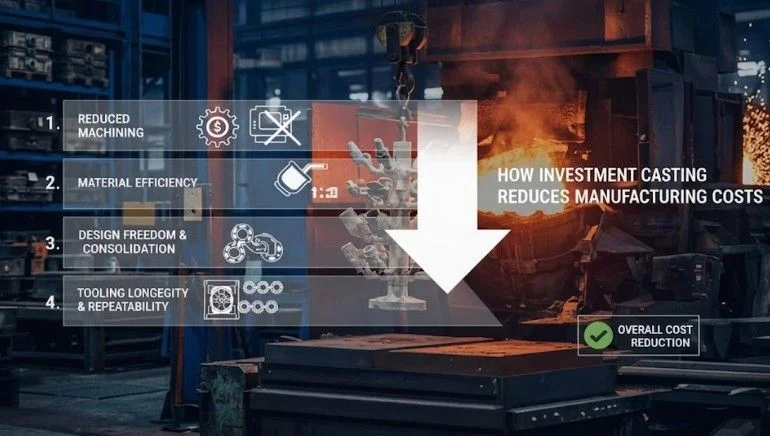
| Feature | Cost Advantage |
| Near-Net Shape | Reduces machining and finishing costs |
| Repeatability | Enables low-cost mass production |
| Smooth Surface | Minimizes secondary processing |
| Complex Design | Eliminates assembly and welding costs |
| Material Efficiency | Reduces raw material waste |
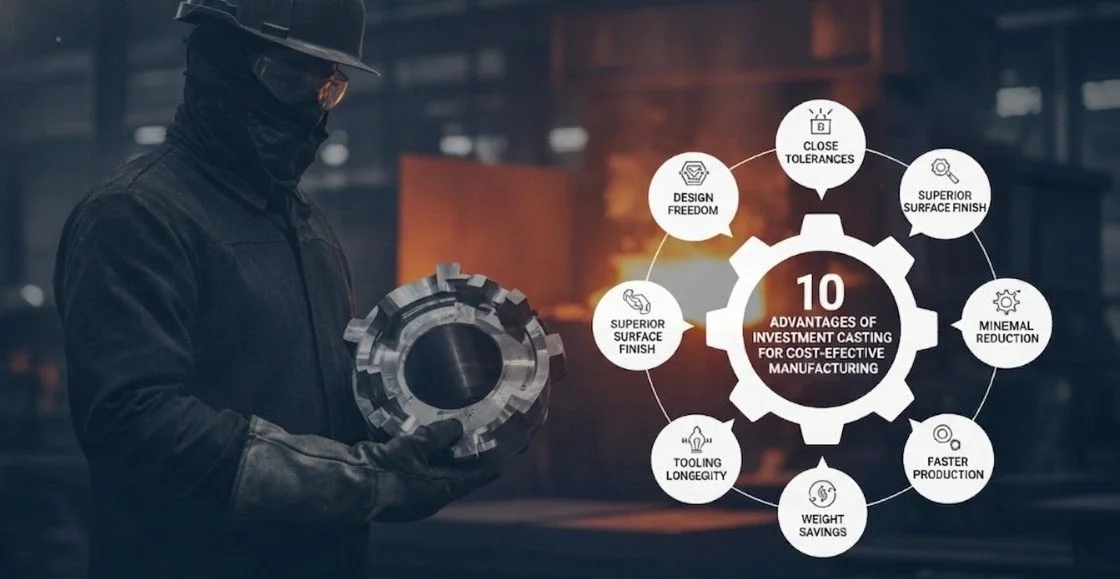
10 Advantages of Investment Casting
1. High Repeatability
Investment casting ensures consistent quality across production runs. Once the mold is developed, identical components can be produced efficiently, reducing per-unit cost.
2. Near-Net Shape Production
Parts are manufactured very close to their final shape, significantly reducing the need for machining, tooling, and labor.
3. Excellent Surface Finish
The ceramic mold produces smooth surfaces, minimizing polishing and finishing costs while improving overall product quality.
4. Ability to Create Complex Geometries
Investment casting supports intricate shapes, thin walls, and internal cavities, eliminating the need for multiple parts and assembly.
5. Reduced Material Waste
This process uses material efficiently, making it ideal for expensive metals and reducing overall raw material costs.
6. Lower Tooling Costs for Complex Parts
Compared to other casting methods, investment casting can be more cost-effective for producing detailed components without expensive tooling changes.
7. Rapid Prototyping
Manufacturers can quickly develop and test prototypes, reducing costly design errors before full-scale production begins.
8. Consistent Quality Through Inspections
Regular quality checks during production help detect defects early, reducing rework and saving operational costs.
9. Wide Range of Material Options
Investment casting supports materials such as:
- Stainless steel
- Aluminum
- Carbon steel
- Bronze
- Superalloys
This flexibility allows manufacturers to optimize cost and performance.
10. Reduced Assembly Requirements
Complex parts can often be produced as a single component, reducing assembly time, labor, and potential failure points.
Applications of Investment Casting
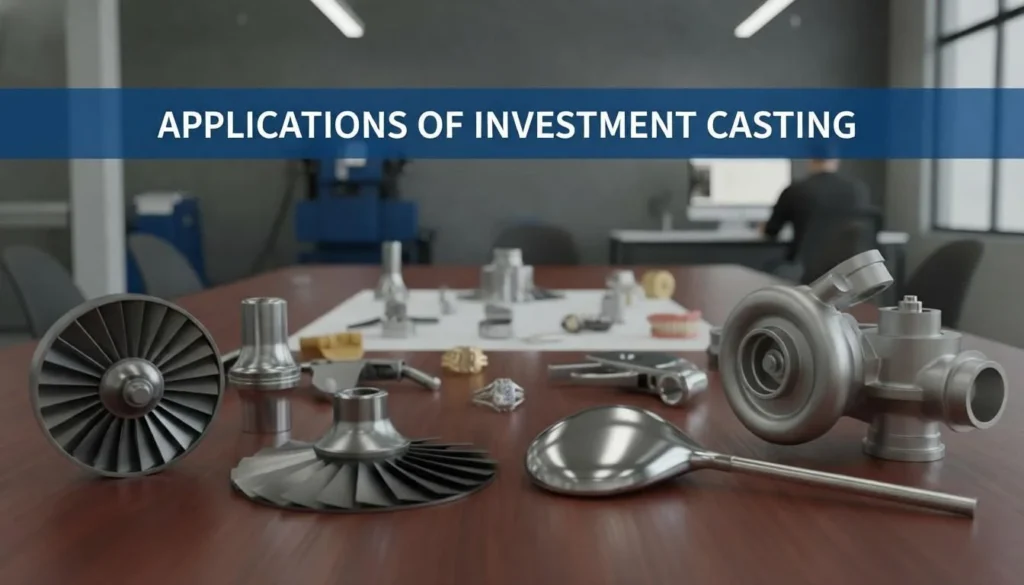
The investment casting process is widely used across industries that demand precision and durability.
- Aerospace: Turbine blades, engine components, and structural parts
- Automotive: Turbochargers, gears, and lightweight components
- Medical: Surgical instruments, implants, and dental tools
- Energy & Power: Valves, pumps, and turbine components
- General Engineering: Gears, levers, and industrial machinery parts
Have a custom requirement? Vodash Engineering provides tailored investment casting solutions for every industry.
Why Choose Vodash Engineering for Investment Casting?
Vodash Engineering is a leading Investment Casting Manufacturers in India, delivering precision-engineered components for industrial applications.
Why clients trust us:
- Advanced casting technology for high accuracy
- Expertise in stainless steel and non-ferrous casting
- Strict quality control and inspection processes
- Skilled engineering team for custom solutions
- Reliable delivery and consistent performance
We don’t just manufacture components, we deliver durable, cost-efficient solutions tailored to your business needs.
Conclusion
The investment casting process is one of the most efficient and cost-effective manufacturing methods for producing complex metal components. With benefits like near-net shape production, reduced waste, and excellent surface finish, it helps manufacturers lower costs while maintaining high quality.
Whether you are in aerospace, automotive, or industrial engineering, investment casting offers a scalable and reliable solution for modern production challenges.
Also Read: https://vodashcasting.com/blog/advantages-of-casting-process/
FAQs
1. How does investment casting reduce manufacturing costs?
It reduces costs through near-net shape production, minimal machining, material efficiency, and high repeatability.
2. Is investment casting suitable for mass production?
Yes, it is ideal for small to medium production runs and can scale efficiently with automation.
3. What materials are used in investment casting?
Common materials include stainless steel, aluminum, carbon steel, bronze, and superalloys.
4. Does investment casting require finishing?
It requires minimal finishing due to its excellent surface finish and dimensional accuracy.
5. Where is investment casting commonly used?
It is widely used in aerospace, automotive, medical, energy, and engineering industries.