
Introduction
In today’s fast-evolving manufacturing industry, selecting the right production method is crucial for achieving precision, efficiency, and cost control. Among various techniques, casting remains one of the most reliable ways to produce complex metal components at scale.
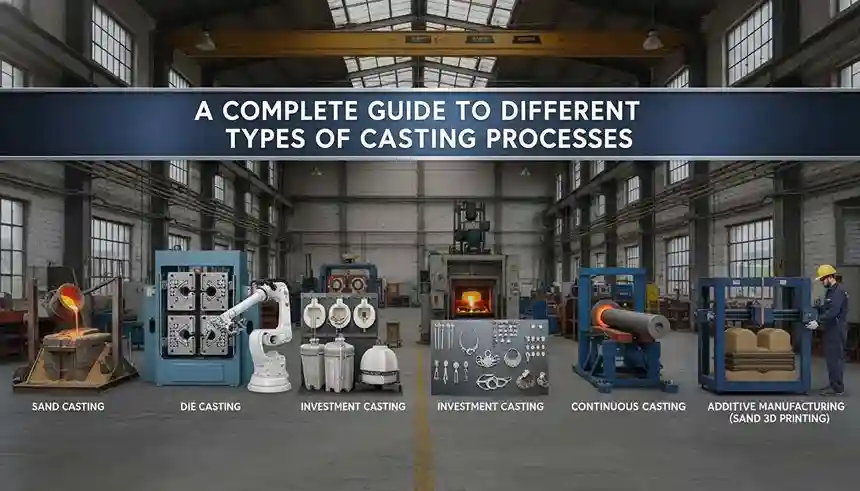
This guide explores the different types of casting processes, their advantages, limitations, and applications—helping you choose the most suitable method for your specific manufacturing needs.
Key Takeaways
- Casting is essential for producing complex metal components with high efficiency
- Different types of casting processes suit different industrial applications
- Common methods include sand casting services, die casting, investment casting, centrifugal casting, lost-foam casting, and permanent mold casting
- Selecting the right casting process depends on cost, material, design complexity, and production volume
- Working with an experienced casting manufacturer ensures quality and consistency
What is Casting?
Casting is a widely used manufacturing process in which molten metal is poured into a pre-designed mold and allowed to solidify into a specific shape. Once cooled, the casting is removed from the mold, cleaned, and finished to achieve the final component.
The types of casting processes vary based on material, complexity, production volume, and surface finish requirements. This method is extensively used in industries such as aerospace, automotive, construction, and heavy machinery due to its ability to create complex and durable components.
Different Types of Casting Processes
1. Sand Casting
Here are the different types of casting process, with its advantages and disadvantage
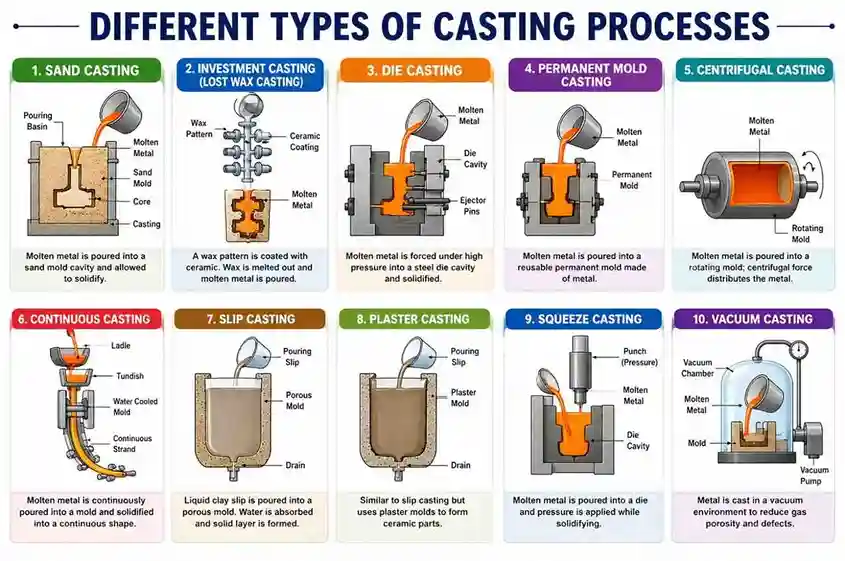
Sand Casting is a versatile casting process that is used to cast metal alloys. It is used for mass industrial production, such as automotive metal casting parts like cylinder heads, engine blocks, crankshafts, etc. Let us talk about its benefits and drawbacks.
| Advantages | Disadvantages |
| Cost-effective for low-volume production | Lower degree of accuracy than other methods |
| Large components fabrication | Hard to use this method for products with pre-determined weight and size specifications |
| Casting ferrous and non-ferrous alloys | It yields products with a rough surface finish |
2. Die Casting
Die Casting is another type of Casting Processes involving molding materials under extreme pressure. Die casting is a manufacturing process where molten metal is injected into a steel mold under high pressure. It is commonly used with non-ferrous metals such as aluminum, zinc, magnesium and copper alloys.
Then the mold will be applied with lubricant, regulate the temperature and remove the workpiece easily.
| Advantages | Disadvantages |
| High production efficiency and suitable for mass production | High initial tooling and mold costs |
| Excellent dimensional accuracy | Limited to metals with lower melting points |
| Smooth and high-quality surface finish | Hard for large or complex shapes |
| Produce thin-walled parts | Less suitable for high-melting-point metals like titanium or steel |
| Reusable molds reduce long-term costs | Shrinkage or Porosity defects may occur if not controlled properly |
3. Investment Casting
What is Investment Casting Process ? Investment Casting is called lost wax casting. It is a process that invests wax pattern with refractory material and bind agent to shape the disposable ceramic mold. Then it poured the molten metal into the mold and made metal castings.
Investment Casting is a labor-intensive process and is generally more suitable for precision components and complex parts rather than very high-volume production. It handles the complex casting of metal parts, like gears, bicycle trunks, moto discs and spare parts, etc.
Many Investment Casting Manufacturers prefer this method because it delivers high dimensional accuracy, excellent surface finish and the ability to produce detailed shapes that are difficult to achieve with other casting processes.
Let’s look at its pros and cons below.
| Advantages of Investment Casting | Disadvantages of Investment Casting Proccess |
| Produce parts with thin walls, high surface quality and more complexity | Requires labor for use |
| Reduces the post-casting machining need | Longer Production cycle |
| Cast hard-to-melt alloys like stainless steel, thin steel, etc. | Higher manufacturing molding costs |
| Due to the breaking away of the shell mold, it allows for castings with 90-degree angles. | New die requirement to create wax patterns for each casting cycl |
4. Centrifugal Casting
Centrifugal Casting is used to produce cylindrical parts using centrifugal forces. This type of metal casting uses a preheated spinning die into which molten metal is poured. The centrifugal forces distribute the molten metal within the die under high pressure. Here are its advantages and disadvantages, given below.
| Advantages | Disadvantages |
| Increase process yields and reduce wastage | Centrifugal casting requires high investments |
| High-density casting and almost no defects | Require skilled labor |
| Convenient process and manufacture barrel and sleeve composite metal casting process | Specific shapes production |
5. Lost-Foam Casting
The Lost-Foam Casting method is similar to investment casting but uses foam for the pattern instead of wax. After forming the pattern, it is coated with a refractory ceramic through dipping, coating, spraying, or brushing. Then, molten metal is poured into the mold to create the desired product.
| Advantages | Disadvantages |
| High precision machining services | Low volume production, High pattern costs |
| Facilitates flexible design | Low strength may damage the pattern and cause distortion |
| Clean production | Many production processes and long delivery times |
6. Permanent Mold Casting
Permanent Mold Casting is a method similar to centrifugal casting and die casting, mainly using reusable molds. It made the mold with steel, graphite, or cast iron, and used for materials like lead, zinc, aluminum, magnesium alloys, certain bronzes and cast iron. Let us look at its cons and pros below.
| Advantages | Disadvantages |
| High-quality surface finish | High initial mold cost |
| Good dimensional accuracy | Limited to metals with lower melting points |
| Reusable molds reduce cost for large production runs | Hard to cast complex shapes |
| Produces dense and strong parts | Not suitable for very small production volumes |
| Faster production than sand casting | Limited flexibility for design changes once the mold is made |
| Produce thin-walled components | Less suitable for metals like titanium or steel |
Why Choose Vodash Engineering for Casting Solutions
Vodash Engineering is a complete metal casting manufacturer offering solutions tailored to your manufacturing needs. With a strong network of trusted suppliers, we deliver high-quality components across multiple industries.
Custom Solutions
We help you select the most suitable casting process based on your product design, material, and budget.
Reliable Supplier Network
Our experienced manufacturers specialize in various types of casting processes, ensuring consistent quality and precision.
Scalable Production
From small batches to large-scale manufacturing, we provide flexible production capabilities to meet your demand.
Partner with Vodash Engineering to streamline your casting operations and achieve superior product quality with cost efficiency.
Conclusion
Casting plays a vital role in modern manufacturing by enabling the production of complex and durable metal components. Understanding the different types of casting processes allows businesses to make informed decisions that improve efficiency, reduce costs, and maintain high quality.
Whether you need precision parts or large-scale production, selecting the right casting method and working with an experienced partner can significantly impact your success.
Also Read: https://vodashcasting.com/blog/metal-casting-process-step-by-step-guide/
FAQs
1. What is casting in manufacturing?
Casting is a process where molten metal is poured into a mold, cooled, and solidified to create a specific shape.
2. What are the main types of casting processes?
The main types of casting processes include sand casting, die casting, investment casting, centrifugal casting, lost-foam casting, and permanent mold casting.
3. What is the difference between sand casting and die casting?
Sand casting uses sand molds and is suitable for large, low-volume parts, while die casting uses steel molds and is ideal for high-volume production with better precision.
4. Which casting process offers the best surface finish?
Investment casting provides the best surface finish and high dimensional accuracy among all casting methods.
5. How do I choose the right casting process?
You should consider factors like material, design complexity, production volume, surface finish, and budget to select the most suitable casting process.