
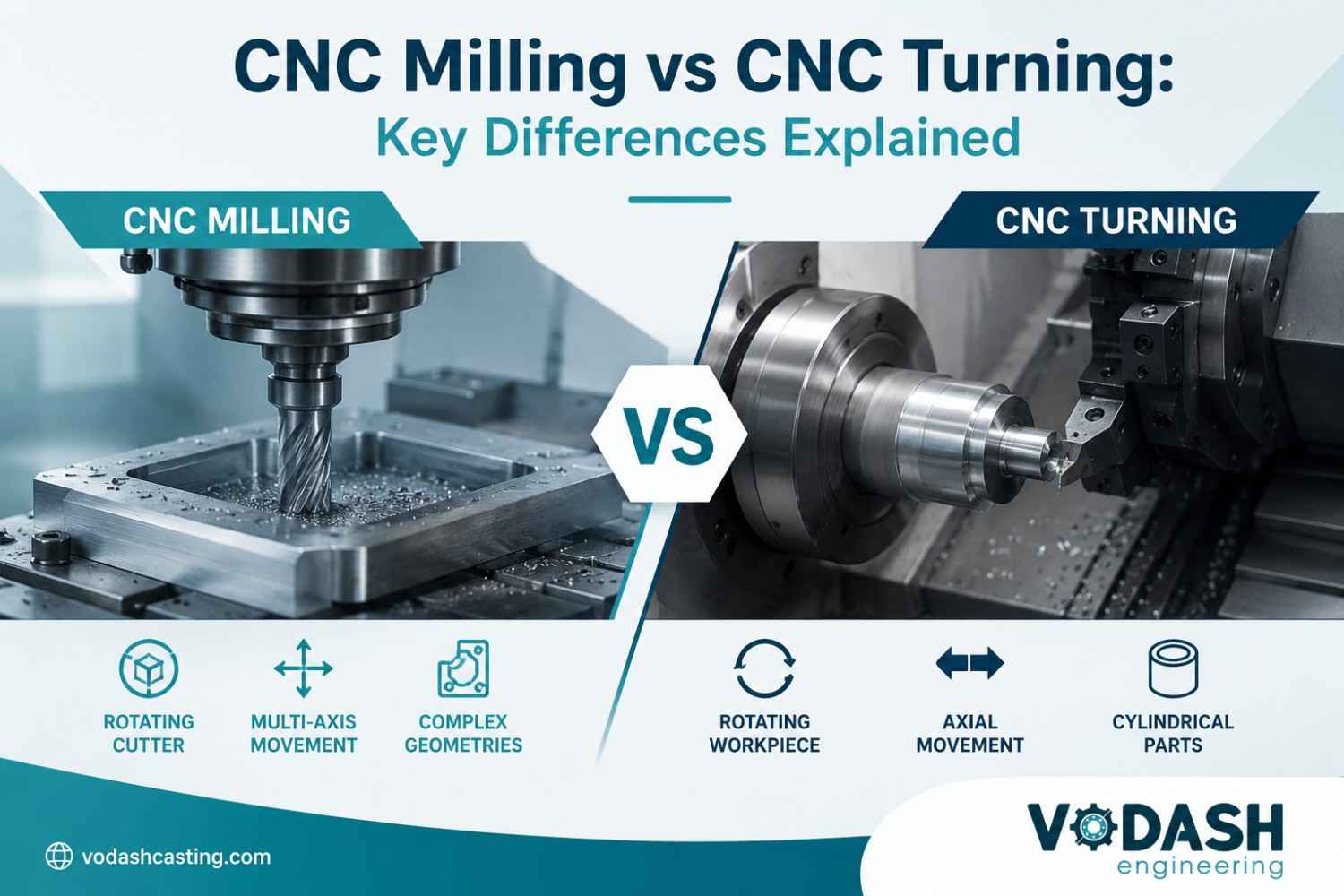
Introduction
CNC milling and CNC turning are two of the most widely used machining processes in modern manufacturing. Both use Computer Numerical Control (CNC) technology to produce highly accurate and consistent components, but they differ significantly in how material is removed and the types of parts they create.
Industries such as automotive, aerospace, medical, railway, oil & gas, and industrial machinery rely on both CNC milling and CNC turning to manufacture precision-engineered components. Understanding the differences between these processes can help manufacturers choose the most suitable method for their production requirements.
Key Takeaways
- CNC milling uses a rotating cutting tool and a stationary workpiece.
- CNC turning uses a rotating workpiece and a stationary cutting tool.
- CNC milling is best for complex and multi-surface components.
- CNC turning is ideal for cylindrical and rotational parts.
- Both processes provide high precision, repeatability, and manufacturing efficiency.
What is CNC Milling?
CNC milling is a machining process where rotating cutting tools remove material from a stationary workpiece to create the desired shape.
The machine can move along multiple axes, allowing it to produce complex geometries, slots, pockets, and intricate features.
Key Features of CNC Milling
- Rotating cutting tool
- Stationary workpiece
- Multi-axis machining capability
- Suitable for complex shapes
- High dimensional accuracy
What is CNC Turning?
The CNC turning process where the workpiece rotates while a stationary cutting tool removes material.
This process is primarily used to manufacture cylindrical, round, and symmetrical components.
Key Features of CNC Turning
- Rotating workpiece
- Stationary cutting tool
- Ideal for round components
- Faster production for cylindrical parts
- Excellent surface finish
CNC Milling vs CNC Turning: Key Differences
| Feature | CNC Milling | CNC Turning |
| Working Principle | Rotating tool cuts stationary workpiece | Rotating workpiece cuts against stationary tool |
| Best For | Complex shapes and designs | Cylindrical and symmetrical parts |
| Machine Type | CNC Milling Machine | CNC Turning Machine (Lathe) |
| Component Shape | Square, irregular, and complex parts | Round and cylindrical parts |
| Production Speed | Moderate | Faster for round parts |
| Tool Movement | Multiple-axis movement | Linear tool movement |
| Complexity Capability | High | Medium |
| Surface Finish | Excellent | Excellent |
Components Manufactured by CNC Milling
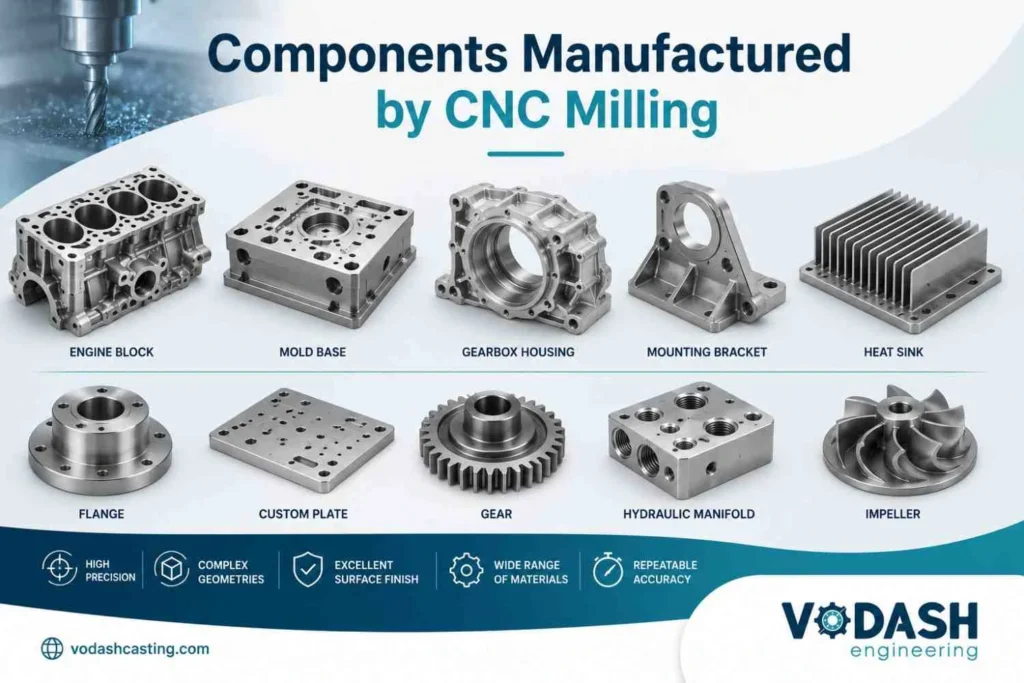
CNC milling is ideal for parts with complex geometries.
Common CNC Milled Parts
- Gear Housings
- Machine Components
- Mold Cavities
- Aerospace Brackets
- Medical Equipment Parts
- Electronic Enclosures
Components Manufactured by CNC Turning
CNC turning is best suited for rotational parts.
Common CNC Turned Parts
- Shafts
- Bushings
- Pins
- Couplings
- Hydraulic Fittings
- Valve Components
Advantages of CNC Milling
Key Benefits
- Produces complex shapes
- Multi-axis machining capability
- High precision
- Excellent flexibility
- Suitable for custom components
Advantages of CNC Turning
Key Benefits
- Faster machining for round parts
- Excellent repeatability
- Superior surface finish
- Cost-effective for high-volume production
- Reduced machining time
When Should You Choose CNC Milling?
CNC milling is the preferred option when:
- Components have complex designs
- Multiple surfaces require machining
- Detailed features are needed
- High customization is required
Best Applications
- Aerospace parts
- Tooling components
- Medical devices
- Custom machinery parts
When Should You Choose CNC Turning?
CNC turning is the ideal choice when:
- Parts are cylindrical or rotational
- High-volume production is required
- Fast machining is important
- Tight tolerances are needed on round components
Best Applications
- Shafts
- Bushings
- Fasteners
- Hydraulic components
Industries That Use CNC Milling and CNC Turning
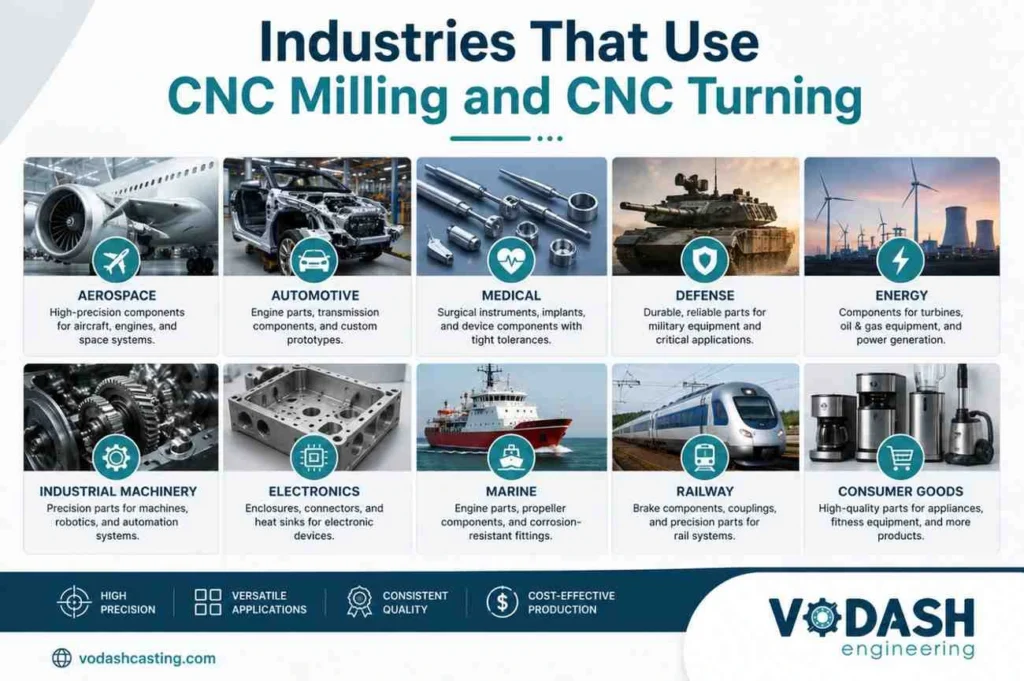
Both processes are essential across various industries.
Major Industries
- Automotive
- Aerospace
- Medical
- Railway
- Oil & Gas
- Electronics
- Industrial Manufacturing
Conclusion
CNC milling and CNC turning are both essential machining processes that play a vital role in modern manufacturing. While CNC milling excels at producing complex shapes and intricate features, CNC turning is ideal for creating cylindrical and symmetrical components with high precision and efficiency.
The choice between CNC milling and CNC turning depends on the component design, production volume, material type, and machining requirements. Understanding the strengths of each process helps manufacturers select the most effective solution for achieving high-quality, cost-efficient production.
Also Read : https://vodashcasting.com/blog/what-is-cnc-turning-machine/
FAQs
1. What is the main difference between CNC milling and CNC turning?
CNC milling uses a rotating cutting tool to remove material from a stationary workpiece, while CNC turning rotates the workpiece against a stationary cutting tool.
2. Which process is better for complex parts?
CNC milling is generally better for complex geometries, pockets, slots, and multi-surface machining operations.
3. Which process is faster?
CNC turning is typically faster for producing cylindrical and rotational components.
4. Can CNC milling and CNC turning be used together?
Yes. Many manufacturers use both processes to produce components that require both rotational and complex machined features.
5. Which industries use CNC milling and CNC turning?
Automotive, aerospace, medical, railway, oil & gas, electronics, and industrial manufacturing industries commonly use both machining processes.