
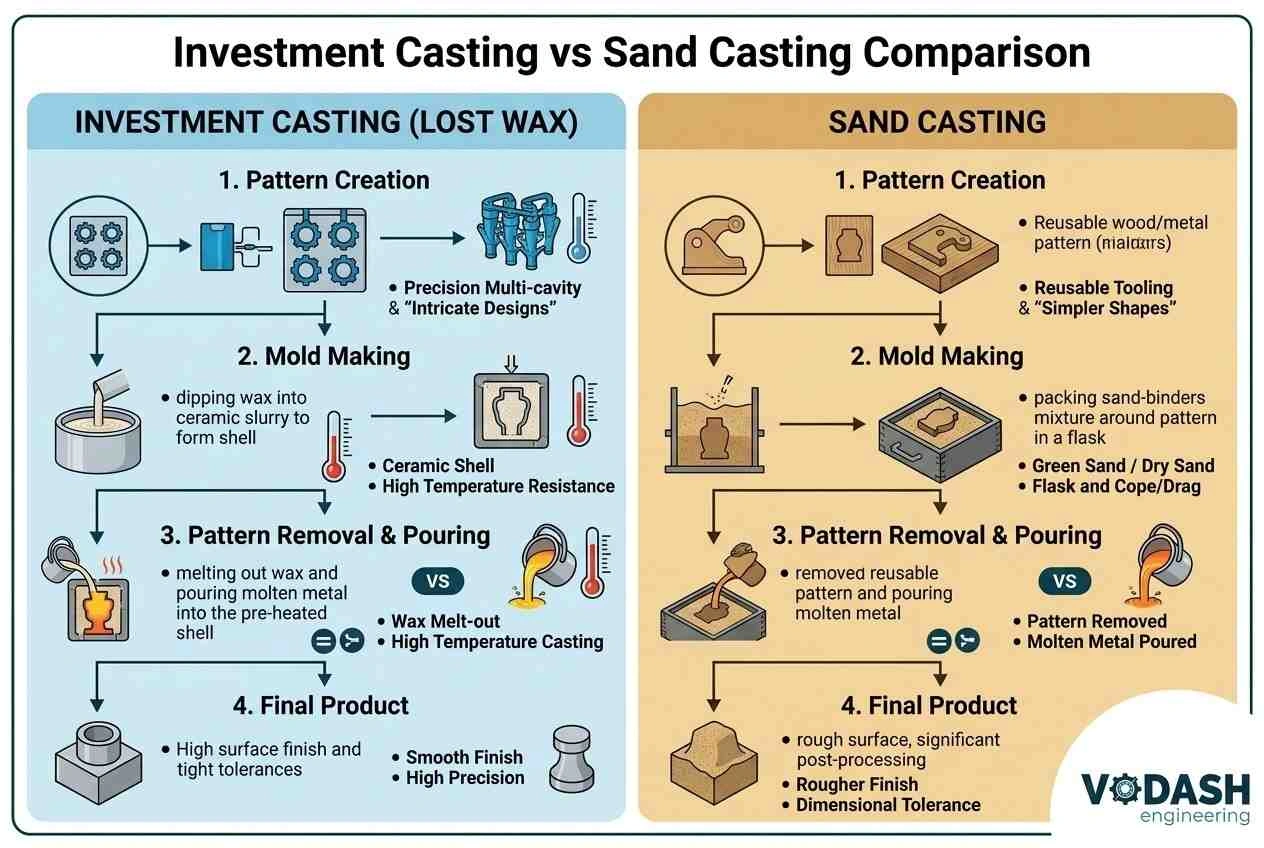
Introduction
Choosing the right casting method can directly impact your product quality, cost, and production efficiency. Two of the most commonly used processes are investment casting and sand casting.
In this guide, we break down the investment casting vs sand casting comparison to help manufacturers, engineers, and buyers make the right decision.
Key Takeaways
- Investment casting delivers high precision and smooth finish, ideal for complex parts.
- Sand casting is cost-effective and versatile, best for large components.
- investment casting foundry has higher initial cost but lower finishing needs.
- Sand Casting requires more machining but has lower setup cost.
- Choose based on budget, complexity, size, and production volume.
What is Investment Casting?
Investment Casting, also known as the lost wax casting process, is a precision casting method where a wax pattern is coated with a ceramic shell. Once hardened, the wax is melted out, and molten metal is poured into the cavity.
Key Features:
- High dimensional accuracy
- Smooth surface finish
- Ideal for complex and intricate parts
- Minimal machining required
What is Sand Casting?
Sand Casting Services is a traditional and widely used metal casting process where molten metal is poured into a mold made of sand, clay, and water. The mold is broken after solidification to retrieve the casting.
Key Features:
- Cost-effective for large parts
- Flexible and versatile
- Suitable for high production
- Widely used in heavy industries
Investment Casting vs Sand Casting (Quick Comparison Table)
| Feature | Investment Casting | Sand Casting |
| Process Type | Lost wax process | Sand mold casting |
| Accuracy | Very high | Moderate |
| Surface Finish | Smooth | Rough |
| Tolerance | Tight | Loose |
| Cost (Initial) | High tooling cost | Low tooling cost |
| Cost (Per Unit) | Lower in bulk | Low for small runs |
| Production Volume | Medium to high | High |
| Part Size | Small to medium | Small to very large |
| Complexity | Highly complex parts | Simple to moderate |
| Machining Requirement | Minimal | More machining needed |
Process Comparison of Investment Casting and Sand Casting
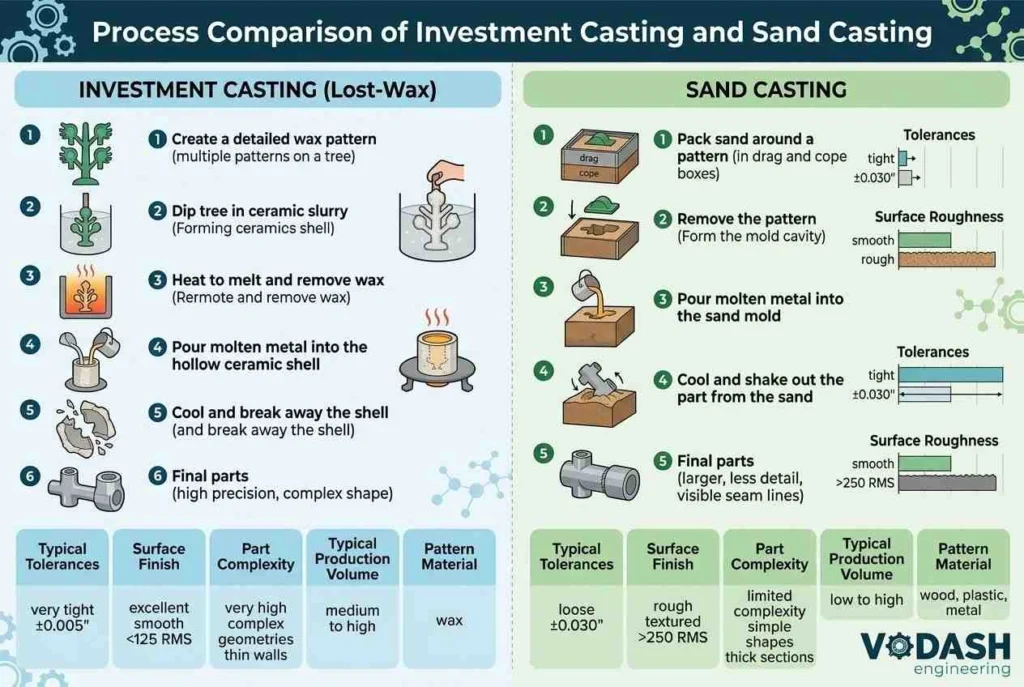
Investment Casting Process
- Wax pattern creation
- Assembly into tree structure
- Ceramic shell coating
- Dewaxing (wax removal)
- Metal pouring
- Shell removal and finishing
Sand Casting Process
- Pattern making
- Sand mold preparation
- Core placement (if needed)
- Molten metal pouring
- Cooling and solidification
- Shakeout and finishing
Advantages of Investment Casting
- Excellent surface finish
- High precision and tight tolerances
- Reduced material waste
- Minimal post-processing
Advantages of Sand Casting
- Low cost and simple setup
- Suitable for large components
- Flexible design modifications
- Widely available process
Disadvantages of Investment Casting
- Higher upfront cost
- Longer production cycle
- Size limitations for very large parts
Disadvantages of Sand Casting
- Rough surface finish
- Lower dimensional accuracy
- Higher chances of defects
- Requires additional machining
When to Choose Investment Casting vs Sand Casting
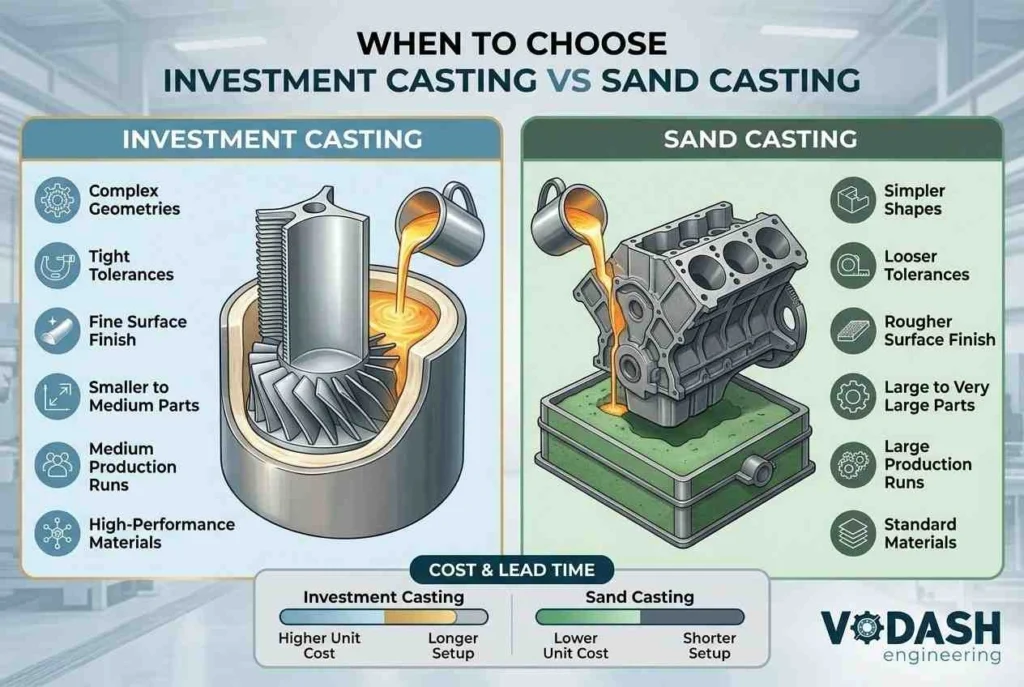
Choose Investment Casting When:
- High precision is required
- Complex shapes are needed
- Smooth surface finish is important
Choose Sand Casting When:
- Budget is limited
- Large parts are required
- Production volume is high
Cost Breakdown Analysis
| Cost Factor | Investment Casting | Sand Casting |
| Tooling Cost | High | Low |
| Production Cost | Moderate | Low |
| Finishing Cost | Low | High |
| Overall Cost (Bulk) | Competitive | Cost-effective |
Conclusion
Both investment casting and sand casting play vital roles in modern manufacturing. The right choice depends on your specific requirements—whether you prioritize precision, cost, or scalability.
Understanding the differences between these two methods helps you make informed decisions that improve product quality and optimize production efficiency.
Also Read: https://vodashcasting.com/blog/green-sand-casting-process/
FAQs
1. What is the main difference between investment casting and sand casting?
Investment Casting offers higher precision and smoother finish, while sand casting is more economical and suitable for larger parts.
2. Which casting method is more accurate?
Investment casting is more accurate with tighter tolerances.
3. Which is cheaper: investment casting or sand casting?
Sand casting is generally cheaper, especially for small production runs.
4. When should you use investment casting?
When you need complex shapes, fine details, and high-quality surface finish.
5. Can sand casting produce complex shapes?
Yes, but with limitations compared to investment casting.