
Inroduction
When it comes to reliable and cost-effective metal manufacturing, sand casting still holds a strong position across industries. At Vodash Engineering, we often see businesses struggle not with whether to use sand casting, but which type of sand casting suits their exact requirement. Understanding the different types of sand casting can make a real difference in product quality, cost efficiency, and production speed.
In this guide, we’ll break down the major types of sand casting, how they work, and where each method fits best, without overcomplicating things.
Key Takeaways
- Sand Casting is highly versatile and remains one of the most widely used metal casting methods used by sand casting manufacturers across industries.
- There isn’t just one method, different types of sand casting are designed for different needs like cost, precision, and production volume.
- Green Sand Casting is the most economical and ideal for high-volume production of simple parts.
- Dry sand casting offers better strength and improved surface finish compared to green sand.
- Loam sand casting is best suited for large and heavy custom components.
- CO₂ sand casting provides stronger molds and better dimensional accuracy for industrial applications.
- Shell molding delivers high precision and smooth surface finish, making it ideal for mass production of detailed parts.
- Each method has trade-offs, so choosing the right type directly impacts cost, quality, and efficiency.
- For best results, it’s important to match the casting method with your project requirements, rather than simply choosing the most common option.
- Working with an experienced manufacturer like Vodash Engineering helps ensure the right process selection and optimal output.
What is Sand Casting?
Sand Casting is one of the oldest and most widely used metal casting process. It involves creating a mold using sand, into which molten metal is poured to form a desired shape.
The basic elements include:
- A pattern (replica of the final product)
- A sand mold
- Molten metal
- Optional cores for internal cavities
Why Are There Different Types of Sand Casting?
Not all casting requirements are the same. Some projects demand high precision, while others prioritize low cost or large-scale production.
Different types of sand casting exist because of:
- Surface finish requirements
- Strength of the mold
- Production volume
- Complexity of design
- Material being cast
Choosing the wrong method can lead to higher costs or poor product performance, something no manufacturer wants.
Main Types of Sand Casting
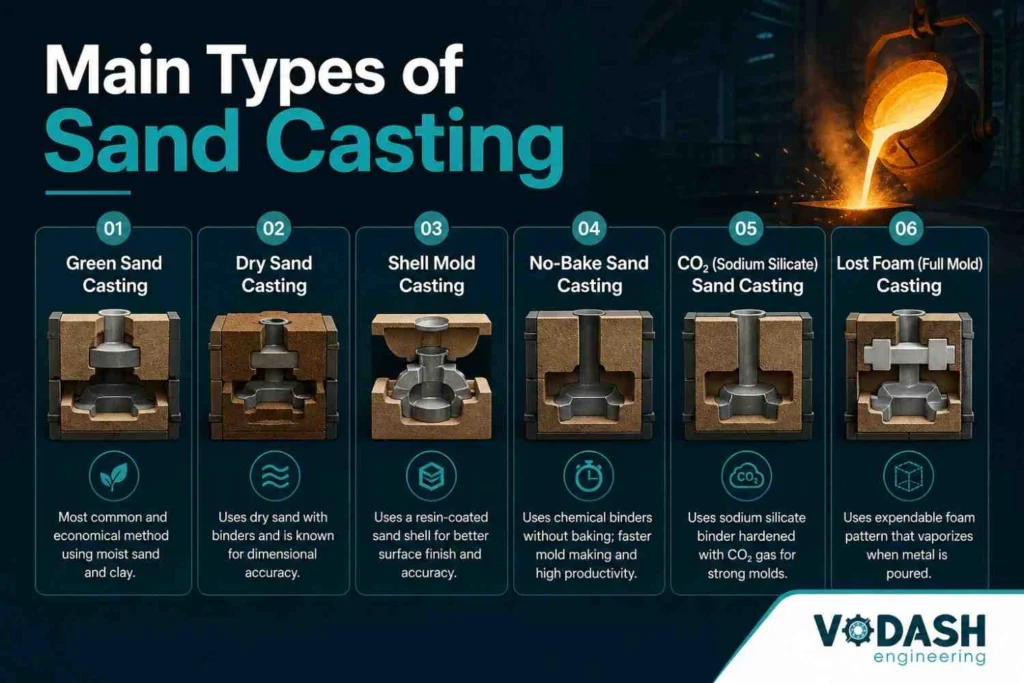
Let’s walk through the most commonly used sand casting methods in real-world manufacturing.
1. Green Sand Casting
This is the most widely used and traditional method.
How it works:
A mixture of sand, clay, and water is used to form the mold. The term “green” simply means the mold is not dried or baked.
Why it’s popular:
- Low cost
- Fast production
- Reusable materials
Where it’s used:
- Automotive parts
- General machinery components
Best for: High-volume production where precision isn’t extremely critical.
2. Dry Sand Casting
Dry sand casting improves on the green sand method by baking the mold before pouring molten metal.
What makes it different:
- Mold is heated to remove moisture
- Results in stronger molds
Advantages:
- Better surface finish
- Higher dimensional accuracy
- Reduced defects
Applications:
- Heavy machinery parts
- Components requiring higher strength
3. Loam Sand Casting
This method is less common today but still useful for very large castings.
How it works:
- Uses a loam mixture (sand + clay + organic materials)
- Mold is built manually around a structure
Ideal for:
Large, heavy components like cylinders or tanks
Why choose it:
Suitable for custom, one-off large castings
4. CO₂ Sand Casting
A more advanced method, CO₂ sand casting uses sodium silicate as a binder and carbon dioxide gas to harden the mold.
Key benefits:
- Strong and rigid molds
- Good dimensional accuracy
- Faster mold preparation
Common uses:
- Engine components
- Industrial castings
This method is often preferred when strength and precision are both important.
5. Shell Sand Casting (Shell Molding)
Shell molding is known for producing high-quality finishes and precise shapes.
Process overview:
- A thin shell of sand mixed with resin is formed around a heated pattern
- The shell acts as the mold
Advantages:
- Excellent surface finish
- High accuracy
- Suitable for automation
Best suited for:
- Small to medium precision parts
- Mass production
6. Investment Casting (Related Process)
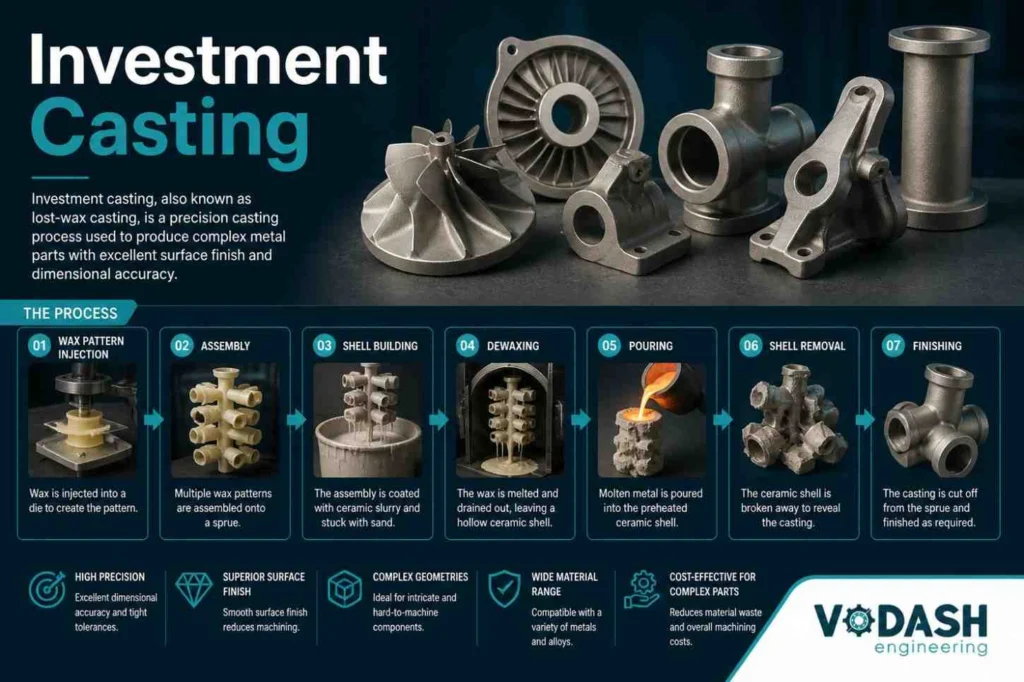
While not strictly a sand casting method, investment casting services is often compared due to its precision.
Why it’s mentioned:
- Offers superior accuracy and finish
- Used for complex designs
Trade-off:
Higher cost compared to sand casting process
Quick Comparison of Sand Casting Types
| Type | Cost | Accuracy | Surface Finish | Best Use Case |
| Green Sand | Low | Moderate | Rough | High-volume simple parts |
| Dry Sand | Medium | Good | Better | Strong, durable components |
| Loam Sand | Medium | Low | Rough | Large custom castings |
| CO₂ Sand | Medium | Good | Good | Industrial precision parts |
| Shell Molding | High | High | Excellent | Mass production precision |
Advantages of Sand Casting
- Works with a wide range of metals
- Cost-effective for both small and large runs
- Ideal for complex shapes
- Flexible production process
- Limitations to Consider
- Surface finish may require post-processing
- Slightly lower accuracy compared to advanced methods
- Additional machining may be needed
Understanding these limitations helps in planning better and avoiding unexpected costs.
How to Choose the Right Sand Casting Method
Choosing the right type depends on a few practical factors:
- Budget: Green sand is cheaper, shell molding costs more
- Volume: High production favors automated methods
- Precision: Shell molding or CO₂ casting works better
- Part size: Large parts may require loam casting
A quick consultation with an experienced manufacturer can save both time and money in the long run.
Conclusion
Sand casting isn’t just one process—it’s a family of methods, each designed for a specific purpose. From simple green sand casting to high-precision shell molding, the right choice depends entirely on your production goals.
At Vodash Engineering, we believe the best results come from selecting the right method, not just the most common one. With the right approach, sand casting can deliver durability, efficiency, and long-term value for your business.
Also Read: https://vodashcasting.com/blog/sand-casting-advantages-and-disadvantages/
FAQs
1. What are the main types of sand casting?
The main types include green sand casting, dry sand casting, loam sand casting, CO₂ sand casting, and shell molding.
2. Which sand casting method is best for large parts?
Loam sand casting is often used for very large and heavy components.
3. What is the difference between green sand and dry sand casting?
Green sand uses moist sand, while dry sand casting involves baking the mold for better strength and finish.
4. Which method gives the best surface finish?
Shell molding provides the best surface finish among sand casting methods.
5. Is sand casting suitable for mass production?
Yes, especially methods like green sand casting and shell molding are widely used for large-scale production.