
Introduction
In today’s fast-evolving manufacturing world, metal casting continues to play a critical role in producing strong, complex, and cost-effective components. At Vodash Engineering, we’ve seen firsthand how the application of metal casting supports industries ranging from automotive to energy by delivering precision machining services at scale.
Whether it’s a heavy-duty machine component or a lightweight automotive part, casting provides the flexibility and durability that modern industries demand. But where exactly is metal casting used and why is it so essential? Let’s break it down.
Key Takeaways
- The application of metal casting spans across multiple industries
- It offers unmatched flexibility, durability, and cost-efficiency
- Different casting methods serve different industrial needs
- Demand is rising with advancements in EVs and renewable energy
What is Metal Casting?
Metal Casting Process is a manufacturing process where molten metal is poured into a mold and allowed to solidify into a desired shape. Once cooled, the casting is removed, cleaned, and finished.
This method is widely used because it:
- Handles complex geometries easily
- Works with various metals like iron, aluminum, and steel
- Reduces machining requirements
Explore more about this in our detailed guide on internal process workflows at Vodash Engineering.
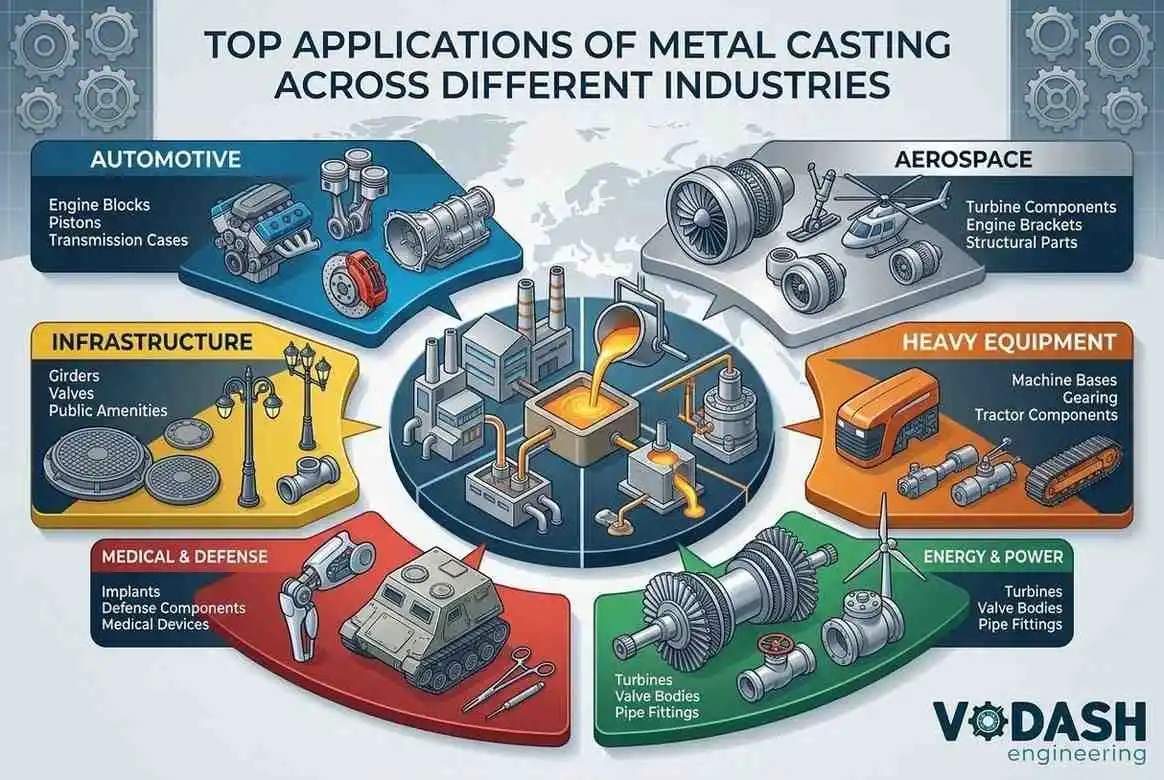
Top Applications of Metal Casting Across Industries
1. Metal Casting in Automotive Industry
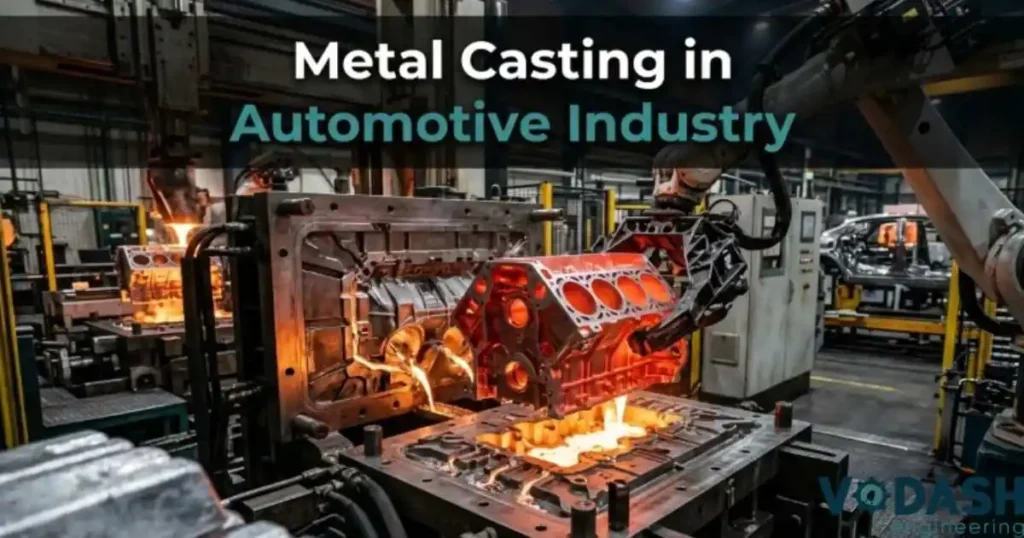
The automotive sector heavily depends on casting for both structural and functional components.
Common applications:
- Engine blocks
- Cylinder heads
- Transmission housings
- Brake components
With the rise of electric vehicles (EVs), lightweight aluminum casting is becoming even more important.
Related: Check our automotive casting solutions page for real-world applications.
2. Aerospace Industry
Precision and reliability are non-negotiable in aerospace, making casting essential.
Used for:
- Turbine blades
- Structural airframe components
- Jet engine parts
Investment casting is particularly popular here due to its high accuracy and surface finish.
3. Construction Industry
From infrastructure to heavy equipment, casting supports the backbone of construction.
Applications include:
- Pipes and fittings
- Structural supports
- Heavy machinery components
Cast iron and steel are widely used due to their strength and durability.
4. Industrial Machinery
Industrial equipment relies on robust and wear-resistant components.
Key uses:
- Pumps and valves
- Compressors
- Machine housings
Casting ensures these parts can withstand continuous operation and harsh environments.
5. Energy & Power Sector
The energy sector demands components that can handle extreme conditions.
Applications:
- Wind turbine hubs
- Oil & gas equipment
- Power plant machinery
Casting enables the production of large, complex parts critical for energy generation.
6. Marine Industry
Corrosion resistance is crucial in marine environments.
Common cast components:
- Ship propellers
- Engine parts
- Offshore equipment
Special alloys are used to ensure longevity in salty and humid conditions.
7. Agriculture Equipment
Farming equipment operates under tough conditions, making durability essential.
Applications:
- Tractor components
- Plow parts
- Irrigation system fittings
Casting provides the toughness required for long-term use in the field.
8. Railways & Transportation
Safety and strength are key in railway systems.
Used in:
- Railway wheels
- Brake systems
- Structural components
Casting ensures reliability under heavy loads and constant use.
9. Consumer Goods & Household Applications
Metal Casting isn’t limited to heavy industries, it’s also part of daily life.
Examples:
- Cookware
- Decorative items
- Hardware fittings
These products benefit from casting’s design flexibility and finish quality.
Types of Metal Casting Used in Different Applications
Different industries use different types of casting processes depending on requirements:
- Sand Casting Services – Ideal for large and simple parts
- Die Casting – Best for high-volume, precise components
- Investment Casting Services – Used for intricate and high-precision parts
- Centrifugal Casting – Suitable for cylindrical components
- Shell Molding – Offers better surface finish than sand casting
Factors Influencing the Application of Metal Casting
Choosing the right casting method depends on several factors:
- Material Type – Aluminum, iron, steel, etc.
- Design Complexity – Simple vs intricate shapes
- Production Volume – Small batch vs mass production
- Cost Efficiency – Budget constraints
- Operating Environment – Temperature, corrosion, load
Understanding these helps casting manufacturer select the most suitable process.
Future Trends in Metal Casting Applications
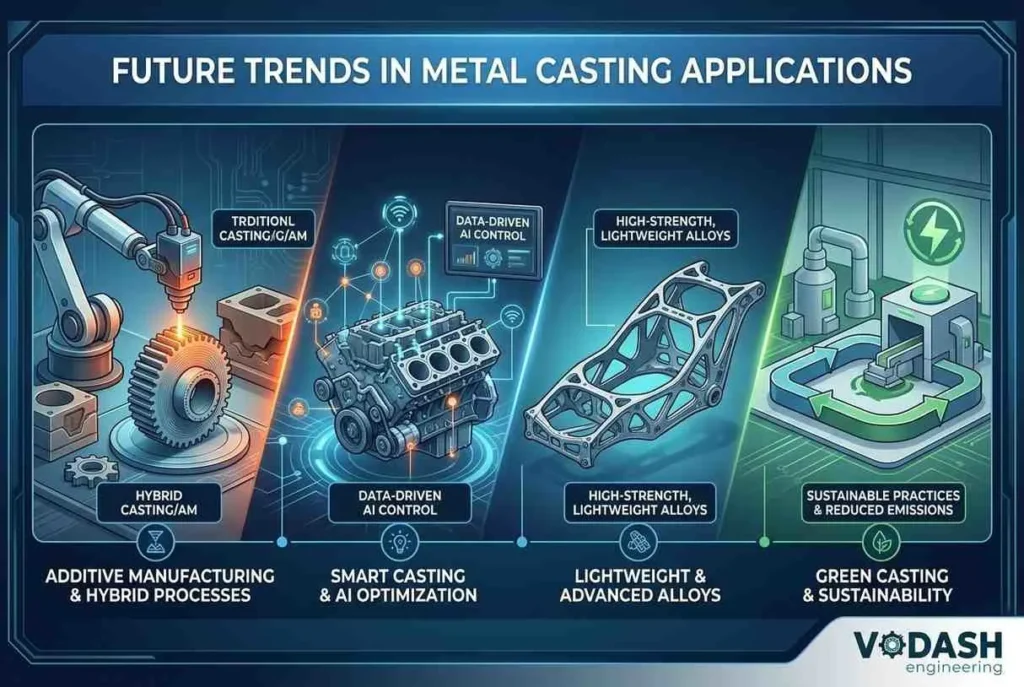
Metal casting continues to evolve with modern technology:
- Automation & Smart Manufacturing
- Sustainable and Eco-Friendly Casting
- Lightweight Materials for EVs
- Growing Demand in Renewable Energy
At Vodash Engineering, we continuously adapt to these trends to deliver innovative casting solutions.
Conclusion
From powering vehicles to supporting infrastructure, the application of metal casting is deeply embedded in modern industry. Its ability to produce durable, complex, and cost-effective components makes it indispensable.
As industries continue to innovate, the demand for advanced casting solutions will only grow. With expertise and a forward-thinking approach, Vodash Engineering is committed to delivering high-quality casting solutions that meet evolving industrial needs.
Also Read: https://vodashcasting.com/blog/sand-casting-process-what-is-sand-casting/
FAQs
1. What are the most common applications of metal casting?
Metal Casting is commonly used in automotive, aerospace, construction, energy, and industrial machinery sectors.
2. Which industries use metal casting the most?
Automotive, construction, and energy industries are among the largest users of metal casting.
3. Why is metal casting important in manufacturing?
It allows the production of complex shapes with high strength at a lower cost compared to other manufacturing methods.
4. What materials are commonly used in metal casting?
Common materials include iron, aluminum, steel, brass, and bronze.
5. Which casting method is best for high precision parts?
Investment casting is widely considered the best for high-precision and intricate components.