
Introduction
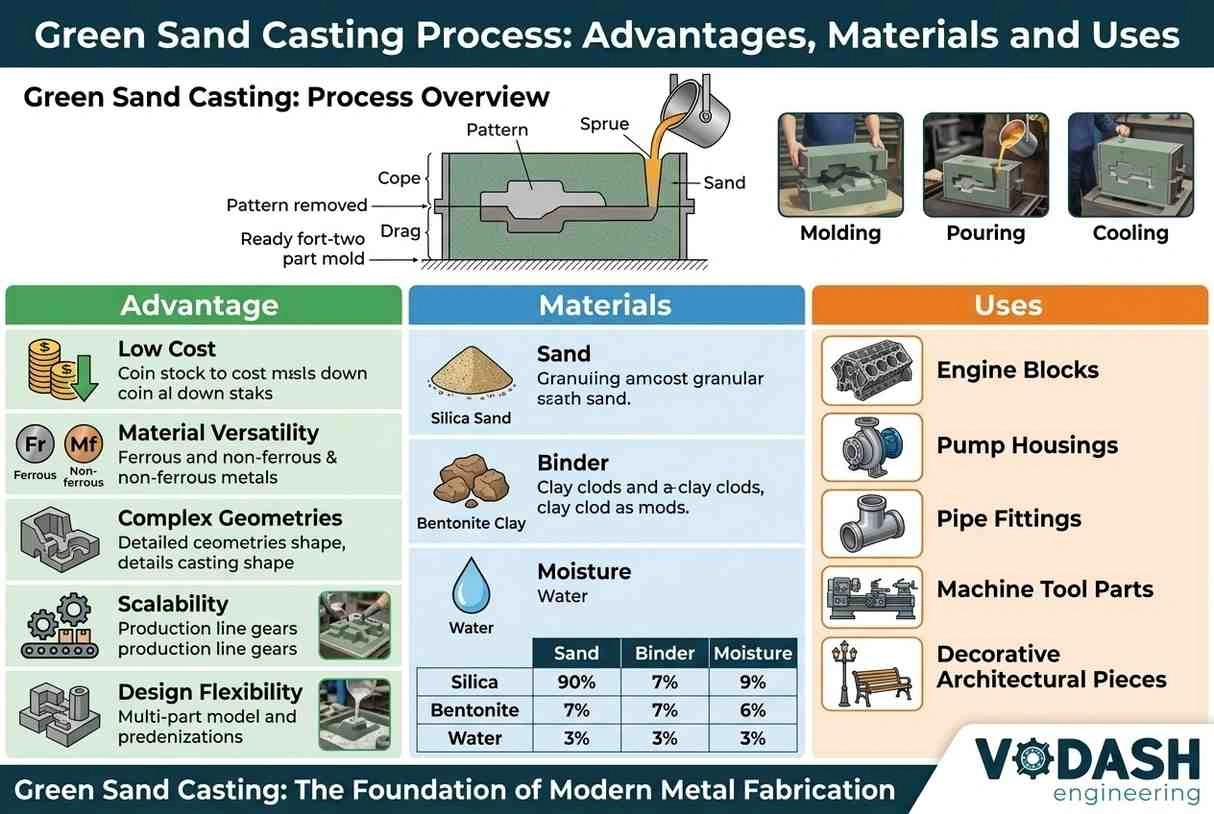
Green Sand Casting is a traditional yet highly efficient casting method that uses a mixture of sand, clay, and water to create molds. The term “green” does not refer to color—it means the sand is moist and not hardened or dried.
This method is widely used because it is economical, reusable, and suitable for producing both small and large metal components.
Key Takeaways
- Green Sand Casting uses moist sand, clay, and water to create molds.
- It is one of the most cost-effective and widely used casting methods.
- The process includes pattern making, mold preparation, pouring, cooling, and finishing.
- Materials like silica sand, bentonite clay, and additives are essential for quality casting.
- It is ideal for automotive, agriculture, and heavy machinery applications.
What is Green Sand Casting?
Green Sand Casting is a process where molten metal is poured into a mold made from moist sand mixed with clay and additives. Once the metal solidifies, the mold is broken to retrieve the final casting.
It is especially popular in foundries due to its simplicity, low cost, and ability to produce complex shapes.
Green Sand Casting Process
Here are the steps in the green sand casting process:
1. Pattern Making
A pattern is a replica of the final product used to create the mold cavity. Patterns can be made of wood, metal, or plastic depending on production requirements.
2. Mold Preparation
A mixture of sand, clay, and water is packed around the pattern to form a mold. Proper compaction ensures strength and dimensional accuracy.
3. Core Making (If Required)
Cores are used to create internal cavities in the casting. These are made separately and placed inside the mold before pouring.
4. Molten Metal Pouring
Molten metal (such as cast iron or aluminum) is poured into the mold cavity through a gating system.
5. Cooling and Solidification
The metal is allowed to cool and solidify. Cooling time depends on the size, shape, and type of metal.
6. Shakeout and Finishing
Once solidified, the mold is broken (shakeout process), and the casting is cleaned, trimmed, and finished for use.
Materials Used in Green Sand Casting
1. Base Sand
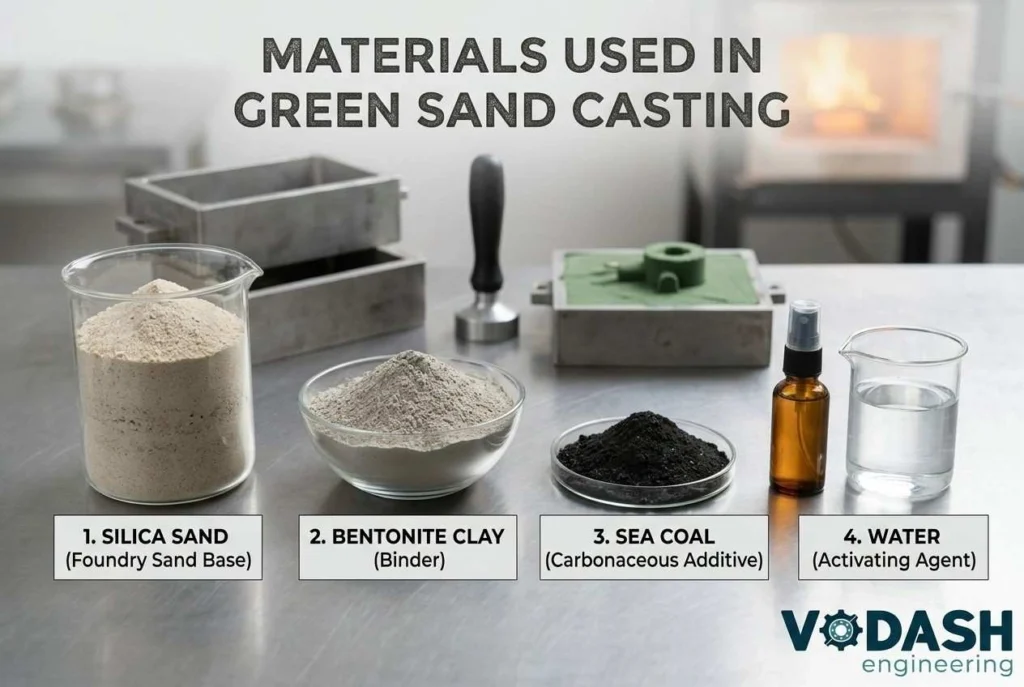
Silica sand is the primary material due to its high melting point and durability.
2. Clay (Binder)
Bentonite clay binds the sand particles together, providing strength to the mold.
3. Water
Water activates the clay and provides the necessary plasticity and bonding.
4. Additives
Additives like coal dust, wood flour, and silica flour improve surface finish and reduce defects.
Green Sand Casting Advantages and Disadvantages
Advantages:
- Cost-effective process with low production cost
- Reusable sand, making it environmentally friendly
- Suitable for complex shapes and large components
- High production rate for mass manufacturing
- Flexible for different metals and designs
Disadvantages:
- Lower dimensional accuracy compared to precision machining services
- Rough surface finish requiring machining
- Moisture-related defects like blowholes
- Not suitable for very thin sections
Types of Metals Used in Green Sand Casting
- Cast iron
- Aluminum alloys
- Brass and bronze
- Steel (limited use)
Green Sand Casting vs Other Casting Methods
- Green sand vs dry sand: faster and cheaper
- Green sand vs investment casting foundry: less precise but economical
- Green sand vs die casting: more flexible but lower accuracy
Future Trends in Green Sand Casting
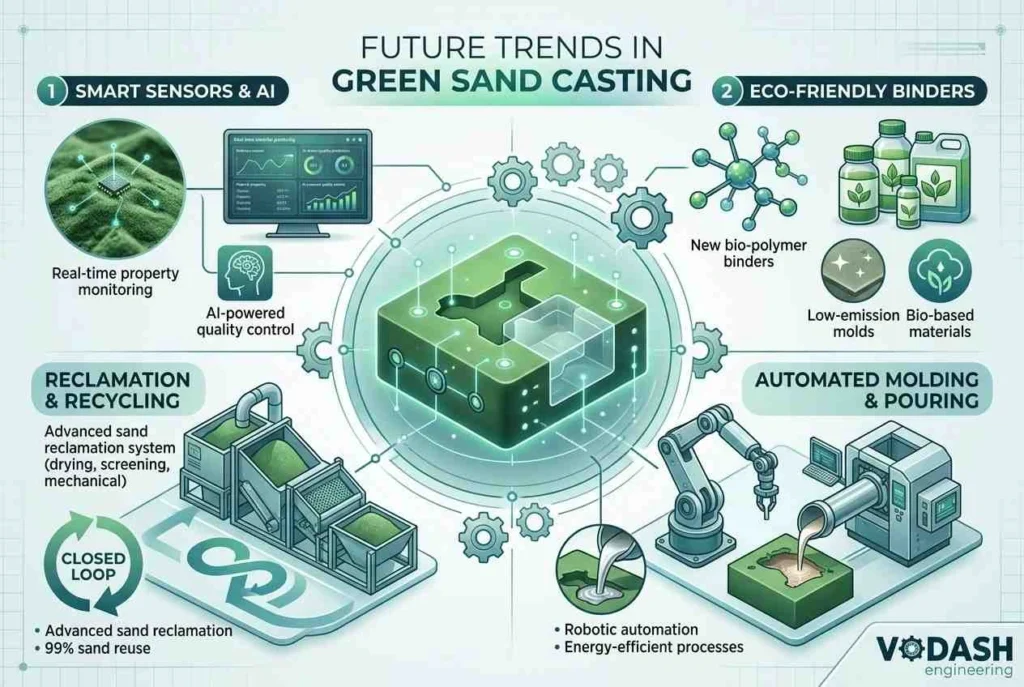
- Automation in foundries
- Eco-friendly binders
- Improved sand recycling
- Smart quality control systems
Conclusion
Green Sand Casting Services remains a highly efficient and economical process in modern manufacturing. Its ability to produce complex parts at scale, combined with its sustainability and adaptability, makes it indispensable across industries.
Also Read: https://vodashcasting.com/blog/investment-casting-vs-sand-casting/
FAQs
1. What is green sand casting?
Green Sand Casting is a method of creating metal parts using moist sand molds.
2. Why is it called green sand casting?
Because the sand is moist and not dried—“green” refers to its condition.
3. What materials are used?
Silica sand, clay, water, and additives.
4. What are the advantages?
Low cost, reusable materials, and flexibility.
5. Where is it used?
Automotive, agriculture, and engineering industries.